
Typical ways to finance a BEE deal:
Last reviewed: 26 November 2026.
Most B-BBEE ownership deals are funded in one or more of the ways below. Each has legal, tax and scorecard consequences.
1. General Principles
- B-BBEE Scorecard Impact: Ownership is a priority element. If the net value sub-minimum is missed, the company’s overall level drops by one, so the funding structure directly affects the score (see Net value).
- Sustainability: The financing structure must be sustainable, allowing the BEE partner to service any debt and ultimately realise the value of their investment.
2. Common Financing Methods
- Vendor Financing:
- The company itself provides a loan to the BEE partner to acquire shares.
- No outside funder is needed, but the company carries the risk that the loan is not repaid.
- Structure: Typically, the BEE partner will form a special purpose vehicle (“SPV”) to hold the shares and it will be the borrower in the transaction. The Company will lend an amount to the SPV. The SPV will use that amount plus any equity contribution by the BEE partner to subscribe for shares in the Company.
- Considerations:
- Terms: The loan should have market-related terms (interest rate, repayment schedule).
- Security: The company might take security over the shares held by the BEE partner.
- Tax: Interest income is taxable in the hands of the company. The BEE partner’s SPV generally cannot deduct the interest it pays: money borrowed to buy shares is used to earn dividends, which are exempt income. Section 24O of the Income Tax Act allows a deduction only in narrow cases, broadly where the buyer ends up holding at least 70% of an operating company so that the two form a group. This is one reason BEE deals are often funded with preference shares instead of loans (see below).
- Companies Act Approvals: A loan to help someone buy the company’s own shares is financial assistance under section 44 of the Companies Act. The shareholders must approve it by special resolution (adopted within the previous two years), and the board must be satisfied that the company will pass the solvency and liquidity test immediately afterwards and that the terms are fair and reasonable to the company. If the SPV is related to the company, section 45 may also apply.
- Third-Party Financing (Bank Loan):
- The BEE partner (usually via an SPV, as above) obtains a loan from a bank or other financial institution.
- Considerations:
- Security: The bank will likely require security, which could include a pledge of the shares, personal guarantees from the BEE partner, or other assets. If the company itself guarantees the loan or gives security for it, that is also financial assistance under section 44 and needs the same shareholder and board approvals.
- Interest Rate: The interest rate will depend on the BEE partner’s creditworthiness and the perceived risk of the investment.
- Repayment: The loan repayment schedule must be aligned with the expected cash flows of the business.
- Development Finance:
- State development finance institutions also fund Black shareholders’ purchases of equity. The National Empowerment Fund (NEF) offers acquisition finance through its uMnotho Fund; the Industrial Development Corporation (IDC) also funds empowerment shareholders in the sectors it supports; and the Public Investment Corporation (PIC), through its Isibaya Fund, invests government pension money in empowerment deals, usually large ones.
- Considerations: Each has its own eligibility criteria and approval process, and its terms differ from bank funding. Check the current criteria with the institution.
- Preference Share Funding:
- A funder (a bank, a development finance institution, or the company itself) subscribes for preference shares in the BEE partner’s SPV. The SPV uses that money, plus any equity from the BEE partner, to buy ordinary shares in the company. The ordinary dividends the SPV receives pay the preference dividends and, over time, redeem the preference shares.
- Structure: Preference shares rank ahead of ordinary shares for dividends and capital repayments. They can be structured with various features, such as:
- Cumulative vs. Non-Cumulative: Cumulative preference shares accrue unpaid dividends, while non-cumulative dividends do not.
- Redeemable vs. Non-Redeemable: Redeemable preference shares can be bought back by the company at a specified time or under certain conditions.
- Participating vs. Non-Participating: Participating preference shares may receive additional dividends if the company performs well.
- Considerations:
- Dividend Yield: The dividend yield should be market-related and sustainable for the company.
- Tax: Preference dividends are not tax-deductible for the SPV that pays them. In the funder’s hands they are generally exempt from income tax and, where the funder is a South African company, from dividends tax, which lets funders charge less than an equivalent loan. Sections 8E and 8EA of the Income Tax Act can make the dividends taxable income for the funder if the preference shares are too debt-like or are backed by guarantees from outside parties. Section 8EA has an exception where the funding is used to buy shares in an operating company, and BEE funding is usually designed to fit it. Get tax advice on the exact terms.
- BEE Codes: The specific terms of the preference shares must comply with the BEE Codes to ensure recognition of the BEE ownership points.
- Solvency and Liquidity: Section 46 of the Companies Act applies. The directors of the Company will need to pass a solvency and liquidity test before the Company can declare any dividends.
- Equity Contributions:
- The BEE partner contributes their own funds to acquire the shares.
- This shows commitment and reduces the need for external financing.
- Considerations:
- Valuation: The company and the BEE partner must agree on a fair valuation of the shares.
- Net Value: Shares paid for in cash carry no acquisition debt, so they count in full towards net value from day one.
- Notional Vendor Finance:
- This is often used where a company cannot or does not want to provide an actual loan.
- Structure: The company issues shares to the BEE partner without a cash loan. The unpaid price is recorded as a notional debt, usually settled from dividends the BEE partner gives up. The BEE partner benefits from growth in the value of the shares above the notional debt.
- Considerations:
- Net Value: The notional debt counts against net value until it is settled (see Net value).
- Tax: May attract adverse tax consequences if not structured correctly.
3. A Simple Diagram
Here is a general diagram that shows how a typical vendor-financed deal might work. The same structure would be used for third-party financing, except that the lender would be a bank:
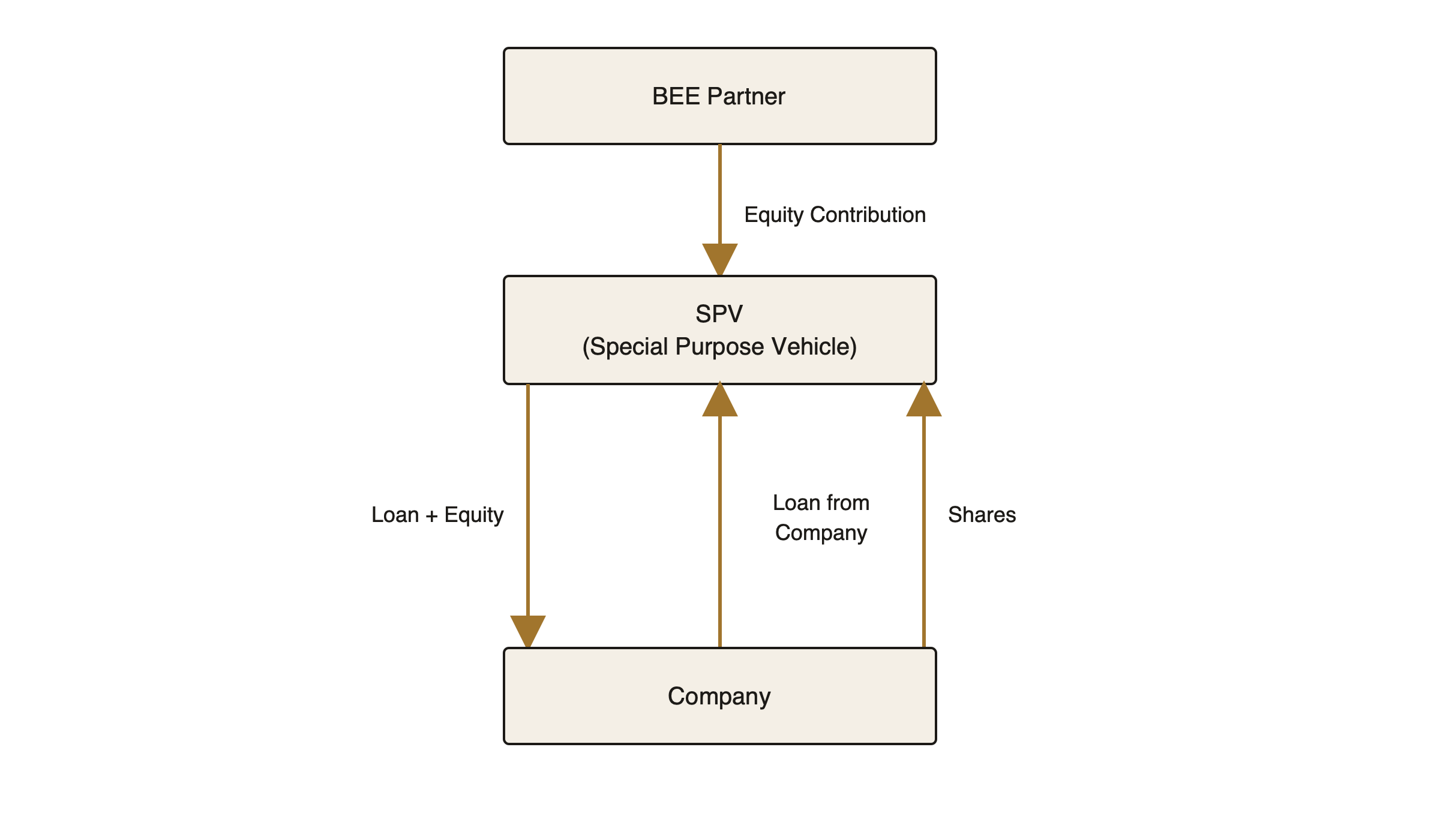
Key:
- BEE Partner: The individual or entity acquiring the BEE stake.
- SPV (Special Purpose Vehicle): A company created specifically for the BEE transaction.
- Company: The company implementing the BEE deal.
- Equity Contribution: Funds provided by the BEE Partner.
- Loan: Funds provided by the Company (Vendor Finance) or a Bank (Third-Party Finance).
- Shares: Shares in the Company issued to the SPV.
4. Important Considerations
- Valuation: Every financing method depends on a fair, independent valuation of the company (see Valuation considerations).
- BEE Codes: All structures must comply with the relevant BEE Codes of Good Practice or Sector Codes.
- Legal and Tax Advice: Get it on the funding terms before they are agreed. The tax rules above (sections 8E, 8EA and 24O) turn on the exact wording.
- Financial Modelling: Before any deal is done, model it to check that it makes sense for the company and that the BEE partner can service the funding from the dividends it will receive.
- Can you get away without financing? Some ownership methods (e.g. options) need little or no upfront capital from the BEE shareholder, because the shares are only paid for when the option is exercised. The cost falls on the company instead: it must pay the option holder the dividends on the optioned shares while the options are held. See Options and warrants for Tusker’s view.
5. Next step
Before you choose how to fund a deal, check what the deal is worth to your business: run your numbers on our ROI calculator.
Speak to us
Want to know what BEE ownership could do for your business? Email info@tusker.co.za or visit tusker.co.za.
BEE Ownership Guide
Get the full guide as a PDF, sent to your email
You also get our weekly newsletter on BEE ownership. Unsubscribe any time.
How we use your details: privacy policy.